The number
Start with the number, because it is doing a lot of work. In the national exit poll conducted by SSRS for NBC News and six other outlets, covering more than 75,000 voters, 56 percent said artificial intelligence and data centers were a "crucial or major factor" in how they voted for Congress. The breakdown: 23 percent called it crucial, 33 percent a major factor, 31 percent a minor factor, and 13 percent said it was not a factor at all.
Among the voters who rated it crucial or major, 64 percent backed Democrats for Congress and 34 percent backed Republicans. Among those who rated it minor or not a factor, the split ran the other way: 57 percent Republican, 41 percent Democrat. That is an association inside a survey, not proof the issue decided anyone's vote. But it is the first hard measurement of something the industry has been feeling for a year: the neighbors are angry.
The caveat the headlines skip
Here is the part most coverage buries. AI and data centers ranked last among the five issues the exit poll asked about. Government corruption led at 90 percent, cost of living at 89 percent, the war in Iran at 74 percent, and immigration enforcement at 73 percent. So the honest reading is narrower than the triumphant one: a clear majority of voters weigh AI infrastructure in their vote, but it remains the least decisive of the big five. Anyone telling you data centers swung the election is overselling it. Anyone telling you they did not matter is not reading the poll.
Where it bit hardest
The issue did not stay abstract. In Ohio, Sherrod Brown made AI data centers and rising electric bills central to his Senate campaign, and won. In Texas, Gina Hinojosa defeated three-term governor Greg Abbott after campaigning for a pause on new data center construction until the state adopts tougher rules. That one rattled the industry: roughly a quarter of all US data center capacity projected to come online by 2030 sits in Texas, according to Jefferies, and JLL projects Texas will overtake Virginia as the world's largest data center market by 2030. In Georgia, Keisha Lance Bottoms, a supporter of a data center pause, took the governor's race. James Talarico beat Ken Paxton for a Texas Senate seat. In Wisconsin, Rebecca Cooke flipped a House seat with the issue in her arsenal.
Zoom out and the night was a Democratic sweep: NBC projects at least 258 House seats, the party's biggest total since 1993, plus seven flipped Senate seats and five governorships. Data centers were not the top reason. But in the states where the concrete gets poured, skepticism won.
Why voters are angry
The grievance is not mysterious, and it is not really about AI. It is about bills and fairness. Data centers are enormous electricity consumers arriving in communities that were promised jobs and are now seeing rate cases, strained grids, and construction noise. A national poll of more than 79,000 voters found 76 percent would oppose the construction of a new data center in their own community. The Washington Post counted at least 29 jurisdictions that have passed bans or restrictions on data centers. Data Center Watch, a research project run by 10a Labs, found at least 45 data center projects disrupted by local opposition in the second half of 2026 alone. And a Data for Progress poll found about three-quarters of voters in Iowa, Michigan, and Ohio were less likely to support a candidate backed by an AI super PAC.
Strip out the technology and this is the oldest infrastructure story there is: concentrated benefits, distributed costs, and a community asking why its power bill funds someone else's margin.
What changes now
The permitting era of the AI buildout is over. For three years, developers sited massive campuses with the confidence that demand justified everything. Now they face moratorium bills, tougher utility scrutiny, and candidates who learned that "pause the data centers" is a winning line in both red and blue states. Evercore analyst Sarah Bianchi told NBC that 2027 is shaping up to be a turbulent year as developers adapt to a shifting policy landscape.
The smart money in the industry is already adapting: power-price guarantees for host communities, water-use disclosures, community benefit agreements. The alternative is more of what 2026 delivered: more bans, more disrupted projects, more losing candidates.
The bottom line
Tuesday did not settle the AI debate. It moved it. For years the argument about data centers lived on tech Twitter and earnings calls. Now it lives in town halls, rate hearings, and governor's mansions, and those rooms vote. The 56 percent is not a mandate. It is a warning light, and it is blinking in exactly the states where the next hundred gigawatts were supposed to go.
Sources
- •NBC News exit poll via Unite.AI
- •WSJ: Data-Center Backlash Key for Democratic Voters
- •The Decoder: AI ranked last among voter priorities
- •Lex on Tech: what the sweep means for tech
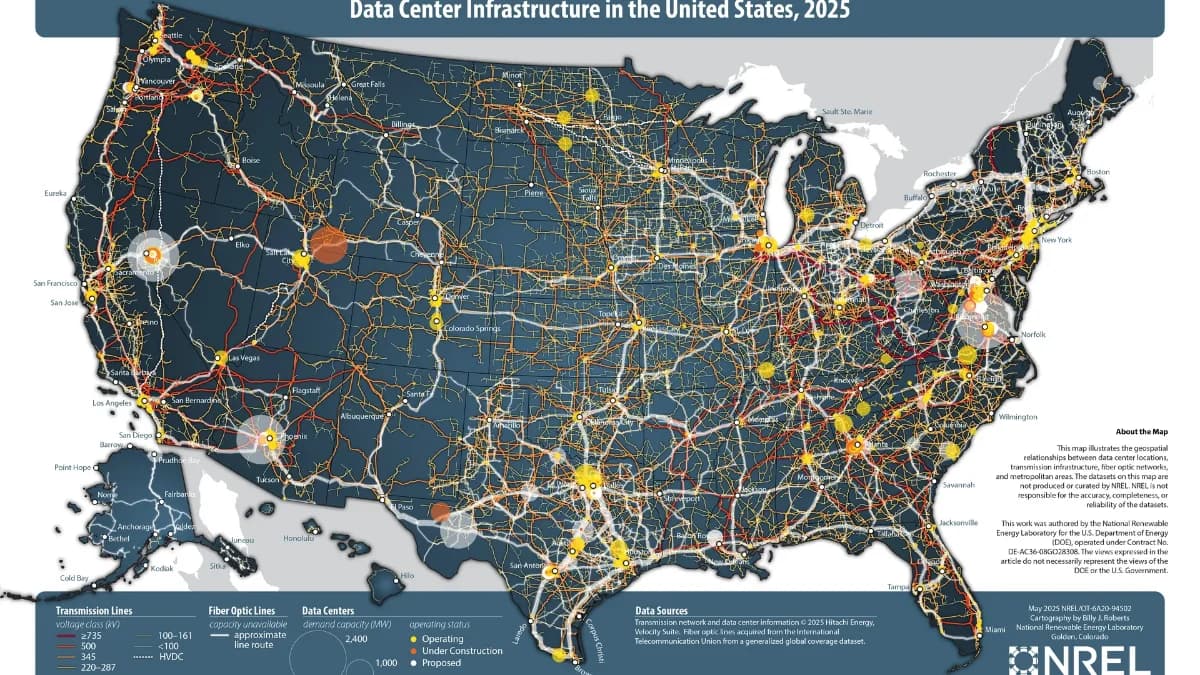
Map: U.S. DOE / National Renewable Energy Laboratory (public domain).
About the Author
Practitioner in full-funnel digital architecture, server-side attribution telemetry, and algorithm-informed media acquisition at Rising36.
Discuss This With Rising36
Questions about AI & Policy? Our team works on this every day — tell us what you're trying to do.