What Google announced
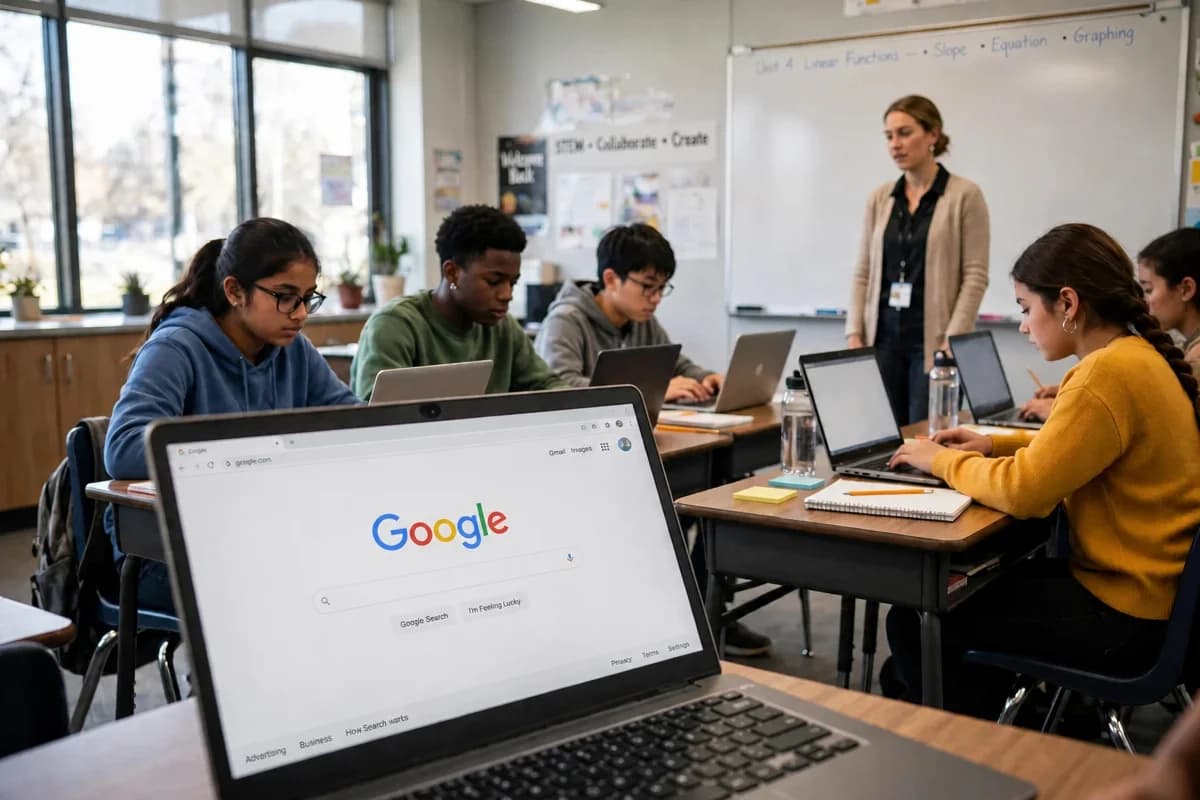
On November 3, Google published a set of blog posts about its education products, written by Chris Phillips, the company's vice president and general manager for education. The core change: for K-12 student accounts, access to Gemini, Gemini Notebook, Gemini in Classroom, and Google Search itself will be entirely off until a school administrator explicitly turns them on. The new controls roll out over the coming months.
On paper, this is a win for schools. In August, Google had gone the other direction, switching certain AI features on by default inside its Classroom platform. Educators pushed back, as The New York Times reported, and Google is now reversing course.
The catch
Then comes the sentence that set the internet on fire. Phillips told the Times that "Search and AI are deeply integrated." In practice, that means a school that decides to keep AI switched off will also lose Search on student accounts. Students will instead see a message from their school saying the feature is not available.
Google later clarified to Engadget that administrators can enable the products individually. It is not, strictly speaking, an all-or-nothing switch. But the underlying coupling remains: there is no version of Search for schools with the AI stripped out.
Why schools are pushing back
The timing matters. In September, New York City placed a one-year moratorium on generative AI tools in public schools through eighth grade. Los Angeles enacted a similar ban the same month. Last week, New York governor Kathy Hochul signed a law restricting AI companies from offering certain chatbot features to minors.
Districts restricting AI are not being technophobic. They are trying to protect academic integrity and students' ability to think without an autocomplete. Google's new structure answers that concern with a dilemma: keep your AI ban and lose the research tool students have grown up with, or accept the AI to keep Search.
The political reaction
The reaction was swift. Senator Bernie Sanders called the move "extortion." New York City mayor Zohran Mamdani accused Google of using "its monopoly power to force AI into our public schools." Google responded on X that the announcement gives schools "more choice, not less," noting that each product ships off by default and can be switched on individually.
The carrot: Guided Learning
Google did not come only with a stick. Alongside the controls, it is rolling out Guided Learning, a tutoring-style mode that walks students through problems step by step instead of handing over answers, with quizzes and interactive checks. It is available globally in Classroom starting this week, and Google is adding it to Search on student accounts as an anti-cheating measure: paste a physics problem into Search and it will prompt the student to think through the concepts. Teachers can review transcripts of the interactions. A US pilot in select schools starts this month.
Why this matters beyond schools
Strip away the education framing and this is a distribution story. Google has poured tens of billions into AI and needs the user numbers to show for it. Chromebooks and Workspace are already widely used in schools, which makes classrooms the most efficient adoption channel available.
The deeper precedent is the coupling itself. If AI is "deeply integrated" into Search, then declining AI means declining Search. That logic will not stay in schools. Every product where AI becomes infrastructure will eventually present the same choice, just less visibly. Schools are simply the first place where the trade-off is being stated out loud.
For school administrators, the practical questions are narrower: audit what your AI policy actually requires, test the individual toggles before the rollout reaches you, and decide whether Guided Learning's transcript visibility fits your student privacy rules. The default is now off. What happens next is, for once, genuinely the school's call.
SOURCES - Engadget: Google says students in schools that ban AI won't have access to Search - Times of India: Google responds to "threatened schools" claims
About the Author
Practitioner in full-funnel digital architecture, server-side attribution telemetry, and algorithm-informed media acquisition at Rising36.
Discuss This With Rising36
Questions about AI & Education? Our team works on this every day — tell us what you're trying to do.